Elemetry Analysis
My understanding of the Real Analysis
Set of Natural Number
There is a set of 5 axioms called Peano Axioms. First 4 of them are obvious and 5th one is a bit confusing. But the 5th axiom lets us use the method of Induction for doing proofs.
A subset of which contains , and contains , whenever contains will be equal to .
This is analogous to the key philosophy we use for proof by induction.
Set of Rational Numbers
First we extent the to have , then a number is a rational number if it can be represented as ratio of two integers, i.e.,
The evolution of number system goes like
- Start counting, we get with addition.
- Then add subtraction to it, we get .
- Now add division, we get .
But there are still holes in the . Think of a graph of function , where roots are . But is not a rational number. In the graph below there’s a hole on axis, where axis is denoting all rational number. Pasted image 20260204185818.png
Rational Zero Theorem
#theorem Suppose are integers and is a rational number satisfying the polynomial below, and . And , where and , then divides and divides .
Only rational solution for of form are solutions where divides and divides .
Interestingly, with the Rational Zero Theorem, one can prove claims such as ” is not a rational number”
For proof, take the polynomial , comparing it to , we have . So only possible rational solution candidates are . One can verify that none of them are solution, so there are no rational solution for this polynomial. This the actual solution is not a rational number.
Set of Real Numbers
Intuitively we talk about as a set with gaps filled of . But actual Development of from is a book to study in itself. For analysis we are directly working with the pretext that as an algebraic system.
Field
A field is a set which satisfies the following properties:
- - Associative law
- : Commutative law
- : Identity element
- For each there’s an element such that, : Inverse
- : Associative law
- : Commutative law
- : Identity element
- For each , there exists such that, : Inverse
- for all : Distributive law
A set with more than one element which follows all 9 properties above is called as a Field. is a field, and is too.
Ordered Field
If there exists an ordering structure, then
- Either or
- If and then . (Transitivity)
- If and , then .
- If then, .
- If and then .
If any field satisfy these 5 properties then it’s called as an Ordered Field. and are both ordered fields. Most of the arithmetic we do are based off this ordered field properties. For real analysis, all the required properties can be derived/proved with help of above. For Real Analysis, we need:
Real numbers, i.e., elements of , can be added together and multiplied together. That is, given real numbers and , the sum and the product also represent real numbers. Moreover, these operations satisfy the field properties 1 through 4 (addition), 5 through 8 (multiplication), and 9 (distributive law). The set also has an order structure that satisfies properties of ordered filed, 1 through 5. Thus, like is an ordered field.
Now interestingly, all the properties which I used to take as obvious assumptions are in fact implications of the field properties. It just is such an ubiquitously used that we take the following as implicit building blocks. That mean, if we take any non-empty set satisfying ordered field properties, we can have these same operations be done one them.
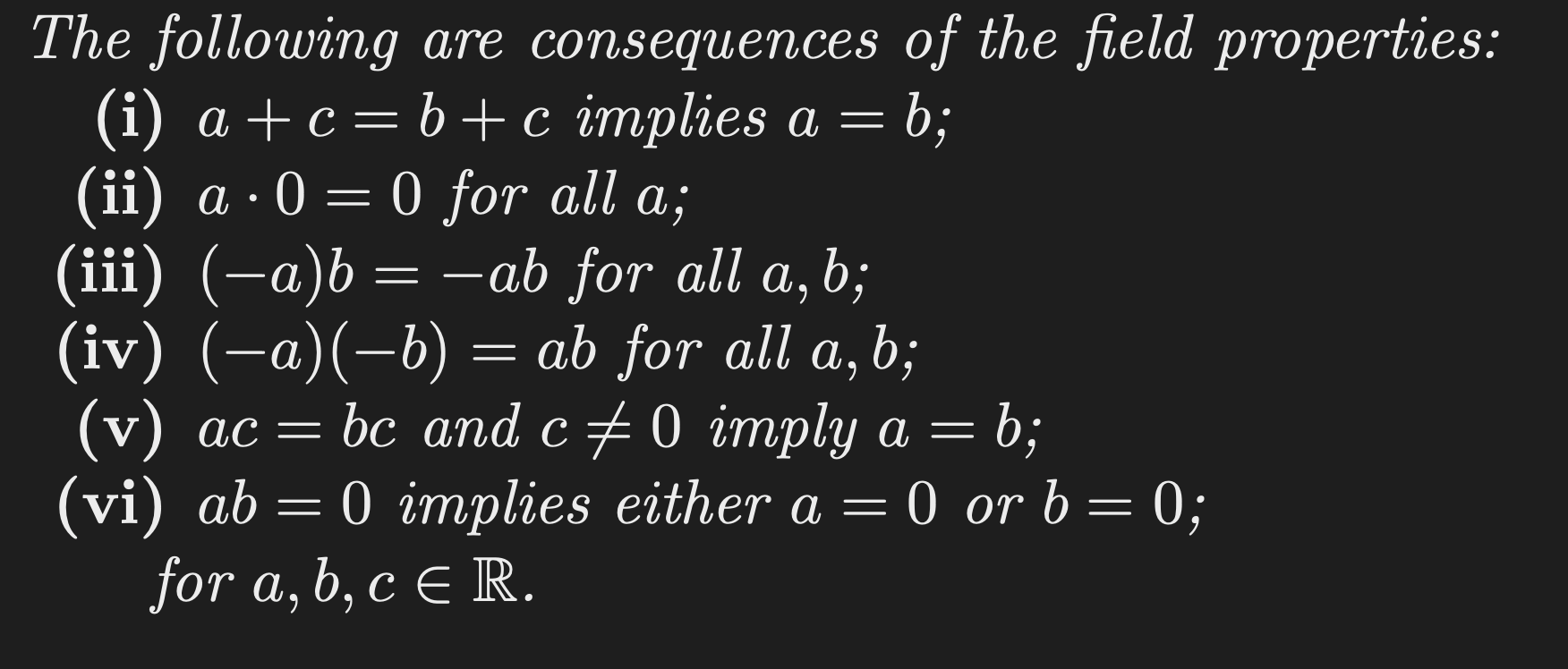
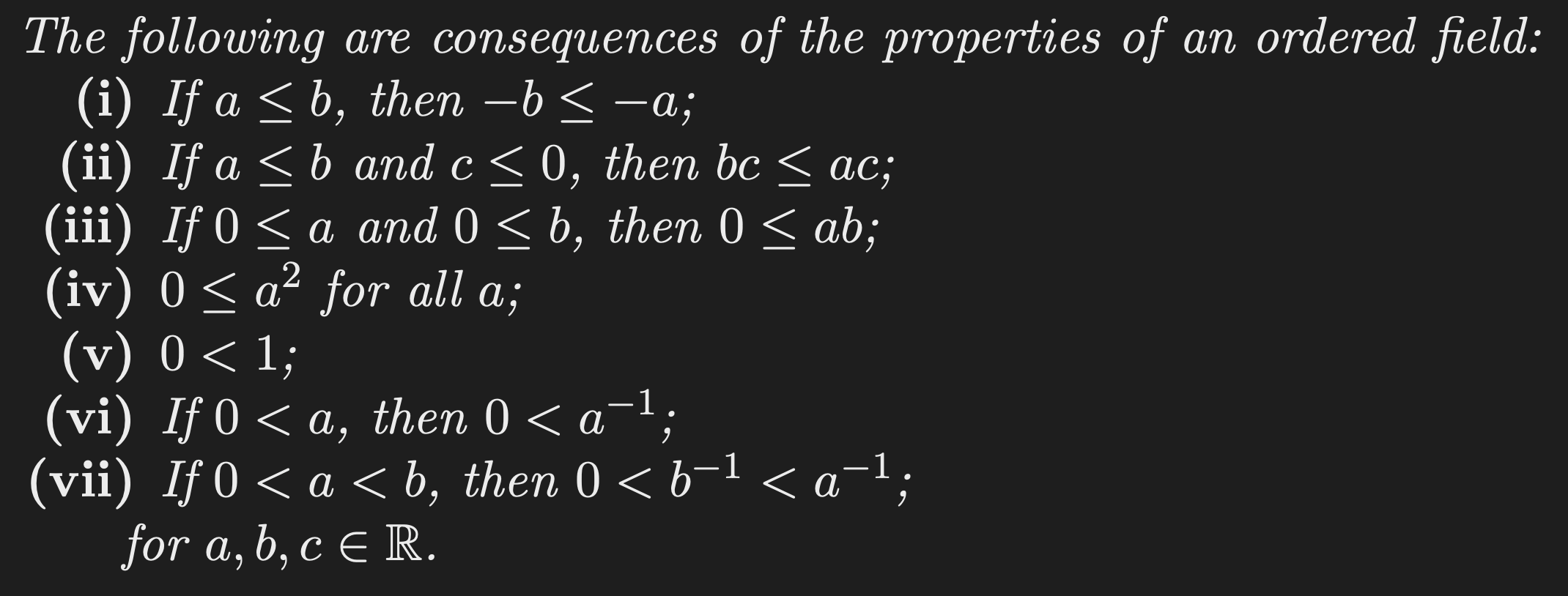
All the above properties can be proved just by using field and ordered field properties.
Distance
For numbers and , we define distance as ; where is absolute value given as:
Theorem 3.5
- for all
- for all
- for all
Corollary 3.6: Triangle Inequality
for all .
This is generally even known as Triangle Inequality.
Completeness Axiom
© 2026 Rudresh Veerkhare